Bilateral Air Services Agreements: How They Actually Get Negotiated
A practitioner's guide to how bilateral air services agreements actually get negotiated, covering the nine freedoms of the air, the typical 12-24 month timeline from initial enquiry to signed instrument, and what determines whether a negotiation succeeds, stalls, or fails.
When a new international route launches, the news framing always credits the airline. “Carrier X launches new route to Country Y.” What the framing leaves out is the treaty underneath. Behind every commercial flight crossing an international border sits a bilateral air services agreement (ASA) between two sovereign states, defining what airlines from each side are allowed to do in the other’s airspace, at what frequency, with what capacity, and on what designation basis.
ASAs are the regulatory bedrock of international air transport. Based on records in the ICAO World Air Services Agreements (WASA) database, more than 4,000 ASAs have been deposited globally. At the ICAO Air Services Negotiation Event (ICAN) 2025, held from 10 to 14 November 2025 in Punta Cana, Dominican Republic, 87 ICAO Member States and 606 delegates reported reaching 440 new and updated bilateral and multilateral agreements in five days. That is the volume of treaty activity required to keep the international aviation network running.
Yet the actual process of negotiating an ASA is poorly understood outside the small community of professionals who do it. Press releases describe outcomes; they do not describe how a state delegation gets from “we should talk” to a signed treaty. This article walks through that process, from first diplomatic enquiry to ratified instrument, including the nine freedoms of the air, the typical 12-to-24-month timeline, the parallel workstreams that run alongside the negotiations themselves, and what determines whether a negotiation succeeds or quietly dies.
1. Why bilateral, when ICAO is multilateral
The Chicago Convention of 1944 created the International Civil Aviation Organization and established the foundational principle of state sovereignty over airspace: every state has complete and exclusive sovereignty over the airspace above its territory. The Convention itself, however, did not grant any commercial traffic rights. Those were intentionally left for states to negotiate separately, either through additional multilateral instruments or, more commonly, through bilateral agreements between pairs of states. The first major such bilateral framework was the Bermuda I Agreement between the US and the UK in 1946, which set the template for the global bilateral system that followed.
The bilateral model has persisted for 80 years despite repeated multilateral liberalisation efforts. The reasons are practical:
- Sovereign control of market access. Each state retains full discretion over which foreign carriers enter its market, on what terms, and under what conditions.
- Reciprocity calibration. Bilateral negotiation lets each side calibrate concessions to match the other’s, in a way that is harder in a multilateral instrument with many parties.
- Politically sensitive sectors. Aviation carries cultural, security, and economic significance that makes states reluctant to delegate decisions to multilateral bodies.
Multilateral agreements like the ASEAN MAAS framework, the EU-US Open Skies Agreement, and the EU single aviation market do exist, and they do important work. But for the vast majority of international city pairs in the world, the operative legal instrument remains a bilateral ASA.
2. The nine freedoms of the air
Any ASA negotiation begins with a shared vocabulary: the nine freedoms of the air. These are the codified categories of traffic rights that a state may grant to foreign carriers. They are not all created equal, and understanding which freedoms are easy to negotiate and which are politically toxic is the foundation of effective ASA work.
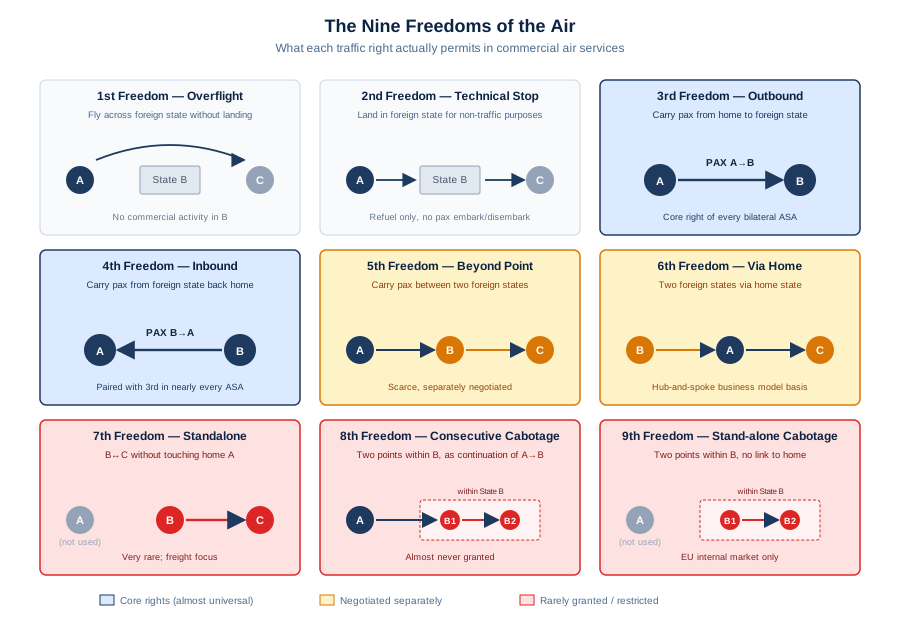
The first two freedoms are technical, not commercial. First freedom is the right to overfly a foreign state without landing. Second freedom is the right to land for technical reasons (refuelling, weather diversion) without picking up or dropping off passengers. Most states grant these freely to most foreign carriers under the International Air Services Transit Agreement, separate from any bilateral ASA.
The commercial freedoms begin with the third and fourth. Third freedom is the right of an airline of State A to carry passengers from A to B. Fourth freedom is the right to carry passengers from B back to A. These are the core rights of every commercial bilateral ASA, granted in pairs because no airline operates one-way services. Negotiating “3rd and 4th freedoms” is the baseline expectation, and an ASA without them is not really an ASA.
Fifth freedom is the right of an airline of State A to carry passengers between two foreign states B and C, as a continuation or precursor of a service originating or terminating in A. Fifth freedom is the first politically sensitive freedom. It allows a foreign carrier to compete directly in a city pair that does not involve its home state, which often draws opposition from the home airlines of B and C. Fifth freedom rights are typically capped by frequency, specific routings, or seasonal restrictions. Based on ICAO WASA data, fifth freedom rights feature in a meaningful but minority share of bilateral ASAs.
Sixth freedom is the right of an airline of State A to carry passengers between two foreign states B and C, via its home state A. The sixth freedom is the foundation of the modern hub-and-spoke business model. Emirates is a sixth-freedom carrier almost by definition: passengers travel London-Dubai-Sydney, with the commercially relevant city pair being London-Sydney, but routed via the carrier’s home hub. Sixth freedom is not always explicitly mentioned in ASAs, because it is technically a combination of 3rd and 4th freedom services that happen to connect via the home state.
The seventh, eighth, and ninth freedoms are restrictive. Seventh freedom allows a carrier to operate between two foreign states without touching its home state at all. Eighth freedom (consecutive cabotage) allows a carrier to carry passengers between two points within a single foreign state, as a continuation of an international service. Ninth freedom (stand-alone cabotage) allows the same intra-state carriage without any link to the home state. These are almost never granted in bilateral ASAs. They survive primarily in deeply integrated common markets like the EU single aviation market, and in a handful of unusual bilateral arrangements.
Most operational ASA discussions focus on 3rd, 4th, and 5th freedoms. 6th is usually allowed implicitly. 7th, 8th, and 9th are off the table from the start of most negotiations.
3. The negotiation timeline
A bilateral ASA negotiation, in the typical case, takes 12 to 24 months from initial diplomatic enquiry to signed treaty, though specific timelines vary widely by jurisdiction and political context.
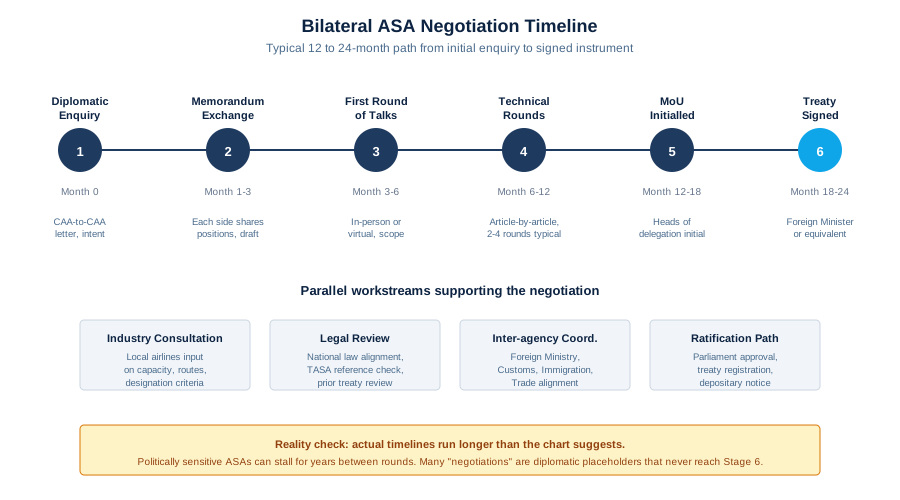
The six stages, in order:
Stage 1 — Diplomatic enquiry. One side’s civil aviation authority sends a formal letter to the other, expressing interest in negotiating or updating an ASA. This is sometimes preceded by informal contacts at ICAN, at IATA events, or through commercial airline lobbying. The letter typically references the existing legal status (no ASA in force, ASA from year X that needs updating, MoU that requires conversion to a full treaty).
Stage 2 — Memorandum exchange. Each side shares its current position: what traffic rights it is willing to grant, what designation criteria it applies, what capacity framework it prefers, and whether it has any specific concerns (security, safety, market protection). These are often shared as memorandum documents rather than draft treaty texts, because committing to specific text too early limits flexibility.
Stage 3 — First round of talks. The first formal negotiation meeting. Stage 3 is mostly scoping: confirming the freedoms to be discussed, the airlines or designation categories involved, and the principal areas of disagreement. First rounds rarely produce text. They produce a shared understanding of what the second round needs to resolve.
Stage 4 — Technical rounds. Two to four further rounds (typical) of article-by-article negotiation. Each side comes with internal positions agreed by its government, and the rounds work through the disputed text line by line. This is where most of the substance gets done.
Stage 5 — MoU initialled. When the heads of delegation reach agreement on all articles, they initial a Memorandum of Understanding. The MoU is not yet a treaty; it is a record of the agreement reached at delegation level, subject to formal signature and ratification by the respective governments.
Stage 6 — Treaty signed. Foreign Ministers (or equivalent senior officials, depending on national constitutional requirements) sign the treaty. The treaty enters into force on a date specified in the text, often after exchange of diplomatic notes confirming completion of internal ratification procedures.
These six stages run sequentially, but four parallel workstreams support the negotiation throughout:
Industry consultation. The civil aviation authority gathers input from its national airlines on what they actually want: which city pairs, what frequency, what designation criteria.
Legal review. The negotiating text is checked against national law, the ICAO Template Air Services Agreement (TASA) for reference language, and any prior bilateral commitments.
Inter-agency coordination. The Foreign Ministry, Customs authority, Immigration authority, and Trade Ministry all get briefed and may have positions on specific provisions.
Ratification path. From Stage 5 onward, the domestic ratification process runs in parallel: parliamentary approval if required, treaty registration with the UN under Article 102 of the UN Charter, and depositary notifications.
4. The disputed articles
Most of the negotiating time within Stages 3 to 5 is spent on a small number of articles where the two sides have genuine differences. The recurring flashpoints:
Designation. Who counts as a “designated airline” of State A for purposes of the ASA. Traditional language requires substantial ownership and effective control by nationals of State A. Modern language, especially in liberalised agreements, allows designation of any airline incorporated in State A regardless of ownership. The difference matters when foreign investors take large stakes in national carriers.
Capacity. Whether the agreement specifies a frequency cap (predetermined capacity), a Bermuda I-style review mechanism (capacity subject to consultation), or full liberalisation (each side decides for itself). Predetermined capacity protects existing carriers but limits market growth. Liberalised capacity reflects modern policy direction but is politically harder to agree.
Tariffs. Whether airlines need prior approval for fares (single approval, double approval, or no approval). Modern ASAs almost always move toward no approval, but some politically sensitive markets retain double-approval clauses.
Code-sharing. Whether airlines designated under the ASA can codeshare with carriers of third states, and on what intra-route segments. This is increasingly important as alliances expand.
Ownership and Control. Closely linked to designation. The traditional 50%+1 national ownership rule is under sustained pressure, but few states have fully abandoned it. The ICAO 2050 Vision adopted at the 42nd ICAO Assembly in October 2025 includes language pushing toward more liberalised ownership provisions, but national legislation lags policy direction.
Aviation security and safety. Standard articles, usually low-conflict because both sides defer to ICAO standards. Occasionally controversial when one side wants to incorporate specific national security requirements.
Doing business. Local representation, currency conversion, ground handling self-handling rights, and similar operational provisions. These are technical but commercially significant, especially for smaller carriers entering unfamiliar markets.
5. Why negotiations stall or fail
Not every ASA negotiation reaches Stage 6. A significant fraction stall or quietly die. The most common failure modes:
Asymmetric market interest. One side wants the agreement urgently (often because it has a carrier ready to launch), the other side has no carriers interested in the reverse direction. The interested side has limited leverage, and the disinterested side has no urgency to compromise.
Domestic political opposition. A national flag carrier lobbies against the ASA because it would face new competition. The CAA may agree to the text at Stage 5, but the Foreign Minister never gets clearance to sign.
Ratification stall. The MoU is initialled at Stage 5, but the legislative ratification process drags on for years. Some MoUs sit in parliamentary committees for a decade or more before either being ratified or quietly abandoned.
Linked issues. Aviation is sometimes used as a bargaining chip in broader bilateral disputes (trade, immigration, territorial). When the broader relationship cools, ASA progress stops.
Designation impasse. The two sides cannot agree on designation criteria. One wants liberalised designation; the other insists on substantial ownership. The negotiation reaches Stage 4 and stays there.
Practitioners learn to read early signals. An ASA negotiation where the other side’s delegation includes only a junior CAA official, no Foreign Ministry representative, and no airline observer is rarely going to reach Stage 6 in any reasonable timeframe.
6. ICAN and the modern negotiation environment
The ICAO Air Services Negotiation Event (ICAN), held annually since 2008, has become the central modern venue for bilateral ASA work. The 2025 event (the 17th ICAN) concluded 440 new and updated bilateral and multilateral agreements in a single five-day window, which is a velocity that would be difficult to achieve through purely bilateral diplomatic channels.
ICAN works by co-locating delegations from many states in a single venue, providing meeting rooms, scheduling support, and access to ICAO reference materials. Reported outcomes from ICAN 2025 include:
- Saudi Arabia signed 17 agreements, including bilateral ASAs with Cape Verde, Paraguay, and Costa Rica, plus operational MoUs with Panama, Liberia, Italy, and Luxembourg.
- Iceland initialled a new ASA with Panama and began negotiations with Ecuador, Tanzania, and Haiti, while concluding designation arrangements with Brazil.
- Guyana signed ASAs with Panama, St. Maarten, Uganda, Ecuador, Liberia, and Kenya.
The pattern is consistent: states use ICAN to compress what would otherwise be multi-month bilateral processes into intensive multi-day sessions. The work is not always conclusive: many “agreements reported” at ICAN are MoUs or records of discussion, not signed treaties. But the velocity is real, and ICAN has become the single most important annual event in the ASA practitioner’s calendar.
The next major policy inflection point is ATConf/7, the Seventh Worldwide Air Transport Conference, scheduled for 16 to 20 November 2026 at ICAO Headquarters in Montréal. ATConf/7 will be held under the theme “Air Transport: Powering Global Connectivity, Economic Development and Resilience in a Dynamic World”, and will review the global ASA framework against the ICAO 2050 Vision. Particular attention is expected to ownership and control liberalisation, fair competition principles, and the integration of sustainability requirements into bilateral instruments. Practitioners working on ASA texts in 2026 are increasingly aware that the policy direction may shift during the year, and are building flexibility into draft text accordingly.
7. The ICAO Template ASA (TASA) and the WASA database
ICAO maintains two key reference resources for ASA practitioners:
The Template Air Services Agreements (TASA) provides three alternative wordings for each major article: a traditional approach (conservative, designation by ownership, predetermined capacity), a transitional approach (partial liberalisation), and a most liberal approach (open designation, free capacity, no tariff approval). The TASA is genuinely useful, especially for states with limited ASA negotiating experience. It saves drafting time, reduces ambiguity, and provides a shared reference point during negotiations.
The World Air Services Agreements (WASA) database is ICAO’s repository of bilateral ASA texts and amendments deposited by Member States under Article 83 of the Chicago Convention. WASA contains the actual treaty texts, codified summaries of provisions, and analytical tools that allow regulators and practitioners to compare provisions across agreements. Reading the WASA entries for the other side’s most recent ASAs with similar states is one of the most valuable preparatory exercises before entering a new negotiation.
8. Three rules for the negotiator
For any practitioner heading into an ASA negotiation:
Rule 1: Read the existing instruments before drafting new ones. WASA tells you what positions the other side has already accepted in writing. Walking into a negotiation without this homework done is amateur work.
Rule 2: Know your own industry’s actual demand. A negotiator asking for unlimited 5th freedom rights from State B, when no home-state carrier has any plans to operate beyond B, is wasting leverage on something that will not be used. The most effective ASA negotiators have specific, current information from their national airlines about which freedoms are commercially valuable on which routes.
Rule 3: Plan for the years after Stage 6. A signed ASA is not the end of the work. It is the beginning of a permanent relationship that requires updates as market conditions change, exchanges of notes to add new capacity, and amendments when freedoms need expansion. The negotiating relationship continues after the treaty signature. Building rapport during the negotiation pays dividends across the entire lifetime of the agreement.
Closing
ASAs are not glamorous. The work happens in conference rooms with delegations of three to six people on each side, over multiple days, often in languages neither side speaks natively. The press release comes at Stage 6 and credits the airlines; the negotiators are typically anonymous in the public record.
But the international aviation network rests on these instruments. Every long-haul flight, every regional connection, every code-share, every cargo route exists because at some point two state delegations sat across a table and agreed on text. The ICAO 2050 Vision, the ICAN annual event, the WASA database, the TASA reference: these are the institutional infrastructure that supports the work.
For the practitioner, the craft has not changed in 80 years, but the volume has compressed. What once took years of correspondence now compresses into ICAN sessions. The fundamentals remain: clear industry input, careful legal drafting, sound inter-agency coordination, patience with the ratification path. Get those right, and the treaty signs itself.
This article describes a generic framework for bilateral air services agreement negotiation based on industry-standard practice. ICAN 2025 figures and individual state outcomes cited are from ICAO official communications and reporting state CAA announcements published in November 2025. The ICAO Template Air Services Agreement and World Air Services Agreements database are maintained by ICAO and available through icao.int. Practitioners should consult their national civil aviation authority’s specific guidance and the current ICAO documentation before undertaking negotiation work.