Why Some Routes Never Launch: Five Reasons Promised Routes Die
A practitioner's analysis of why announced or planned airline routes quietly never launch. Five recurring failure patterns from regulatory death to silent shelving, with early warning signals network planners can use to recognise a dying route before more resources are committed.
The aviation press tracks route launches enthusiastically. Carrier X announces new route to Y, photographs at the inaugural, ribbon cutting at the destination terminal, op-ed about regional connectivity. The press does not track the routes that get announced and then quietly disappear, the ones that sit on internal planning slides for two years and then drop off the next quarter’s strategy deck without a single press release. There are far more of these than the public realises.
In the previous article on how a route actually gets launched, I walked through the 90-day timeline from board approval to first commercial flight. This article is the photographic negative of that one. It is about the routes that never reach Day 90. Specifically, it is about the five recurring patterns by which promised routes die, the early warning signals that experienced network planners learn to read, and what (if anything) can be done to save a route in trouble.
The patterns are observable across the global industry. Every senior network planner has lived all five at some point in their career. Recognising them early is the difference between losing six weeks of work and losing six months.
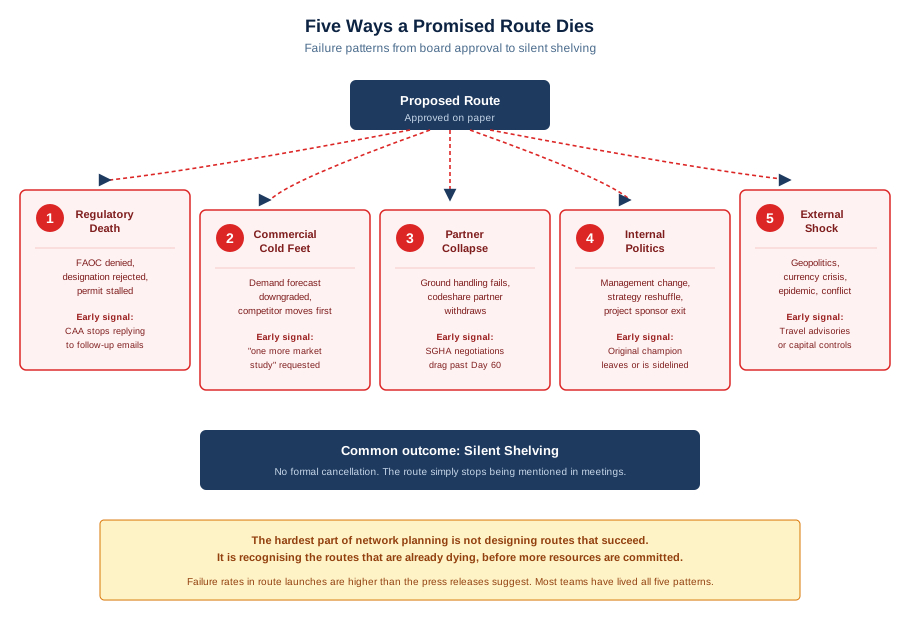
1. Regulatory Death
The route requires a permit, a designation, an FAOC, or a traffic-rights confirmation that does not come. The application is filed, follow-up emails are sent, in-person meetings are requested. The civil aviation authority on the other side responds politely for a while, then less frequently, then not at all. Eventually the project sponsor realises that the regulatory door is not opening, and probably never will.
This pattern is the most common cause of route death globally. It is also the one most resistant to recovery, because the airline has no leverage. A CAA that decides to slow-walk a permit application has hundreds of administrative reasons to do so, none of them formally rejections, none of them appealable. The route does not die in a single rejection. It dies in a series of unanswered emails over six to twelve months.
The underlying causes vary by jurisdiction. Sometimes the issue is political: the destination state is protecting its national carrier and quietly blocking foreign competition. Sometimes it is structural: the ASA between the two states has frequency caps that the proposed route would exceed, and no one is willing to renegotiate. Sometimes it is bureaucratic: the application got assigned to a junior official who lacks authority to approve it and has no incentive to escalate. Sometimes it is interpersonal: an incident from a prior carrier interaction soured the CAA on the airline’s home country generally.
Early warning signal: the CAA stops replying to follow-up emails within their previously normal response time. A CAA that previously replied within five business days, now silent for fifteen, is sending a signal. It is rarely the signal carrier teams want to read, but it is the signal nonetheless.
Can it be saved? Sometimes, if the airline can route the issue through diplomatic channels (foreign ministry to foreign ministry, rather than CAA to CAA). But by the time a route reaches this point, the home carrier has usually exhausted its diplomatic capital on other priorities, and the foreign ministry has no appetite for spending political capital on a single commercial route. Most regulatory-death routes are not saved. They are quietly shelved.
2. Commercial Cold Feet
The route passed board approval based on a commercial case that looked sound at the time. Three months later, demand forecasts come in softer than expected. A competitor announces a parallel route at lower fares. Fuel prices spike. Currency moves the wrong way. The original case still works on paper if you believe the forecasts, but the executive committee no longer believes the forecasts.
The result is not a formal cancellation. It is a request for “one more market study” before final sign-off. Then another study. Then a request to wait until the next quarter’s commercial review. Then a quiet reassignment of the project sponsor to a different priority.
This pattern is particularly common at carriers with strong financial discipline and weak network strategy commitment. The numbers always look unattractive enough at any particular moment to justify deferral, because route economics that depend on building demand always look unattractive in the first six months. A carrier that requires a route to look profitable on month one will never launch a new route.
Early warning signal: the phrase “one more market study” or “let’s revisit this at the next strategy review” appears in meeting minutes. Once a route is in study cycle without a forcing function, it is in the slow lane to death.
Can it be saved? Yes, but only with executive sponsorship. A network strategy director who will personally champion the route through the executive committee can break the study cycle. Without that sponsor, the route stays in study until everyone forgets it was ever proposed.
3. Partner Collapse
A new international route depends on partners the airline does not control. Ground handling at the destination station. Fuel supply contracts. Customs and immigration coordination. Sometimes codeshare partners or interline agreements with carriers at the other end. Cargo handlers if the route carries belly freight.
When any of these partners fails to come together, the route dies. Ground handling negotiations stall over service-level requirements. The destination airport refuses to allocate a check-in counter at the requested time. The fuel supplier cannot guarantee uplift speed for the rotation pattern. The codeshare partner withdraws because their commercial assumptions changed.
These failures are individually small. None of them is the kind of dramatic obstacle that makes for a story. But cumulatively they accumulate friction until the launch date becomes impractical, and the project quietly moves to “next year” status.
The category includes shareholder or ownership-structure complications, when a route requires the launching carrier to meet specific ownership thresholds in the destination state and the carrier’s actual ownership structure does not meet them. This is particularly relevant for ASEAN routes touching states that retain substantial-ownership requirements in their bilateral ASAs. A route can collapse not because the commercial case is weak or the regulators are obstructive, but because the carrier’s cap table cannot be reshaped to satisfy a foreign jurisdiction’s nationality requirement.
Early warning signal: the Standard Ground Handling Agreement (SGHA) negotiations drag past Day 60 of the launch timeline. Ground handling should be a 30-day process for a competent station. When it takes longer, the issue is rarely commercial. It is usually that one party has lost interest and is signalling so through procedural delay.
Can it be saved? Sometimes, by switching partners. A different ground handler, a different fuel supplier, a different codeshare partner. But each switch costs weeks, and the cumulative delay can push the route past the practical commercial window. Many partner-collapse routes are saved technically but commercially DOA by the time they launch.
4. Internal Politics
The route had a champion. A specific executive, a specific commercial director, a specific network strategy lead. The champion made the case to the board, drove the analysis, owned the timeline, fielded the questions. Then the champion left the company. Or got reassigned to a different region. Or lost an internal political battle and was sidelined.
The route does not die because anyone formally cancelled it. It dies because nobody is left who feels ownership of it. The new commercial director has their own priorities. The new network strategy lead has their own routes to launch. The original analysis sits on a server, technically still approved, but unowned.
This pattern is especially common in carriers undergoing leadership transition, ownership change, or strategic restructuring. The first casualty of a management reshuffle is always the previous management’s pipeline of in-progress initiatives.
Early warning signal: the original champion leaves, is promoted out of the operational line, or is publicly sidelined in a restructuring. Within 60 days of the champion’s departure, the route is almost always dead, even if no one has noticed yet.
Can it be saved? Only if the route can find a new champion. New champions for inherited projects are rare. Most executives prefer to launch their own initiatives rather than inherit their predecessor’s, especially when the inherited initiative has not yet succeeded. Routes that depend on continuity of personnel are structurally fragile.
5. External Shock
A pandemic. A geopolitical crisis. A regional conflict. A sudden currency devaluation in the destination market. A military coup. A volcanic eruption that closes airspace. A new sanctions regime that makes payment flows impossible. A travel advisory that makes the route commercially unviable for at least a year.
External shocks are the most dramatic form of route death and also the most defensible from a corporate communications perspective. Nobody blames the network planner for a coup. The route is shelved, the carrier focuses on more stable markets, and the announcement (if there is one) is framed as a temporary deferral rather than a cancellation.
The aviation industry has experienced an unusual concentration of external shocks in the past five years: COVID-19, the Russia-Ukraine war and the resulting Russian airspace closures, multiple Middle East flashpoints, the Myanmar political crisis affecting routes into RGN, and various smaller regional disruptions. Routes that were viable in 2019 became non-viable in 2020 or 2022 or 2024, through no fault of any commercial or operational decision.
Early warning signal: travel advisories at level 3 or higher from major source-market governments (US State Department, UK Foreign Office, ICAO advisory bulletins). Currency controls or repatriation restrictions in the destination market. Any of these makes a route’s commercial case fragile, and the next adverse event can finish the case.
Can it be saved? Usually no, at least not on the original timeline. External shocks change the underlying market conditions in ways that no commercial mitigation can recover. The mature response is to formally shelve the route, document the rationale, and revisit when conditions normalise. The naïve response is to insist that the original commercial case still holds, which leads to launching into a shock and losing money.
The pattern across all five
Looking across these five failure modes, three observations are worth highlighting:
First, route deaths are rarely dramatic. There is almost never a formal cancellation meeting. There is no announcement to the press. The route simply stops being mentioned in network planning meetings, drops off the strategy slide deck, and disappears from internal forecasts. By the time anyone notices the route is dead, it has been dead for weeks. This is uncomfortable for the network planners who worked on it, but it is consistent with how organisations handle quiet failures: through silence, not through acknowledgement.
Second, the failure modes overlap. A route rarely dies of exactly one cause. The more common pattern is that one failure mode weakens the route (regulatory delay), which exposes it to a second failure mode (commercial cold feet), which exposes it to a third (the project champion gets reassigned because the route is no longer perceived as winning). The compound failure is what actually kills the route, not any single cause.
Third, early warning signals are observable but rarely acted on. Every experienced network planner can list the signals in retrospect. The problem is that in real time, optimism bias and sunk-cost reasoning keep the project alive past the point where realistic assessment would have called it. The CAA’s silence gets rationalised as “they’re busy.” The market study delay gets rationalised as “due diligence.” The champion’s departure gets rationalised as “the case is strong enough to stand on its own merits.” Each rationalisation is plausible. Together they keep dead routes on planning slides for months.
What this means for the planner
For a network planner working on route launches, three practical implications:
Implication 1: Build a kill criterion before kick-off. When the route is first approved, write down the specific conditions under which the project will be paused or cancelled. CAA non-response past 30 days. Commercial forecast downgrade more than 20%. Partner SGHA delay past 75 days. Champion departure. By writing these criteria down at the start, when emotion is low, the team gives itself permission to call death when the criteria are met.
Implication 2: Run a quarterly review against the kill criterion. Once per quarter, the route should be reviewed against the original kill criteria. Not against an optimistic restatement of the case. Against the criteria as written. If the criteria are met, the route is paused or killed. If not, it continues. This discipline is uncomfortable but it is what prevents the months-long zombie phase that consumes resources without producing a launch.
Implication 3: Plan for failure, communicate failure clearly. A killed route is not a personal failure of the network planner. It is a normal outcome of network planning in environments with regulatory uncertainty, partner dependencies, executive turnover, and external shocks. The planner’s job is to make the best case the data supports, monitor the signals, and call the kill cleanly when the case stops holding. Carriers that punish planners for killed routes end up with planners who keep dead routes alive on slides to protect themselves, which is much worse for the organisation than honest kill calls.
Closing
The asymmetry in aviation press coverage is striking. Successful route launches get press releases, ribbon cuttings, ministerial speeches, and op-eds. Failed route launches get nothing. The carrier moves on. The planner moves on. The destination state’s tourism board moves on. Within a year, the route’s death is institutional memory, not institutional fact.
This produces a distorted public picture of how route development actually works. It looks, from the outside, like a sequence of announcements that all become operations. From the inside, it is a sequence of attempts where a substantial fraction never reach Day 90. Recognising this is not pessimism. It is calibration. Network planners who understand the failure modes plan for them. Network planners who do not, get surprised by them, again and again.
The hardest part of network planning is not designing routes that succeed. It is recognising the routes that are already dying, before more resources are committed.
This article describes generic failure patterns based on industry-standard observations of route launch processes. Specific examples and patterns vary substantially by carrier, jurisdiction, and market context. The patterns described are common to global regional aviation operations and are not associated with any specific carrier or route.