Wide-body Comparison: 787-9 vs A350-900 vs A330-900neo in Asian Long-haul Markets
A practitioner's comparison of the three modern long-haul wide-bodies that dominate Asian long-haul markets. Range, capacity, trip cost, and the demand thresholds where each aircraft wins.
The Asian long-haul market is essentially a three-aircraft conversation. Pull up the seat map for any major flag carrier in the region (Singapore Airlines, Cathay Pacific, Japan Airlines, All Nippon Airways, Korean Air, Air China, China Eastern, Vietnam Airlines, Thai Airways), and the long-haul fleet will be some mix of three families: Boeing 787, Airbus A350, and Airbus A330neo. The 747 and A380 era ended; the next-generation aircraft now do the work.
The narrowbody-to-widebody decision is straightforward: if the route is over about 3,000 nm with substantial pax demand, you need a widebody. Below that distance, narrowbody types like the A320 family or the Boeing 737 family handle the work. The harder decision sits above 3,000 nm: which widebody. This article walks through that question, focusing on the three aircraft that dominate the modern Asian long-haul fleet.
The numbers used are realistic regional operating values. Specific operator economics will vary; the framework should not.
1. The three aircraft
At the heart of the comparison are three aircraft families:
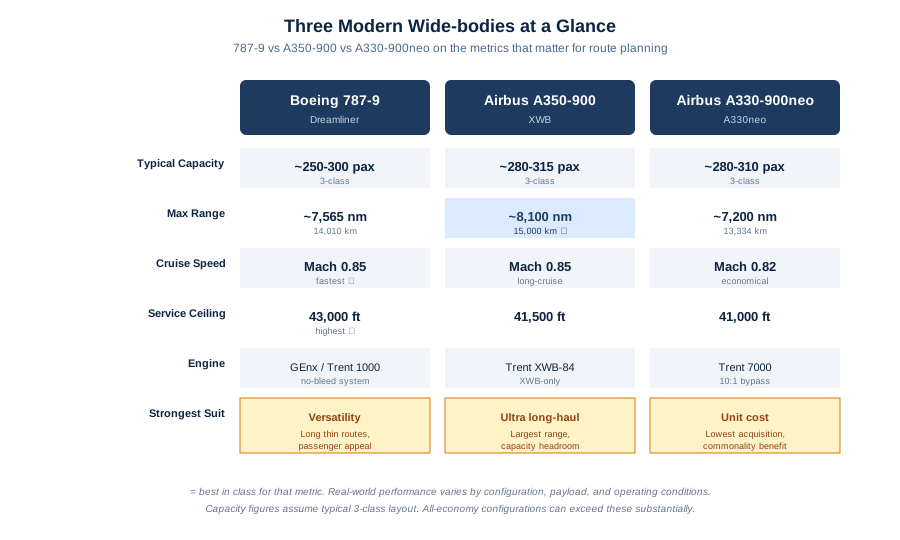
Boeing 787-9 Dreamliner. The mid-size variant of the Dreamliner family, with three siblings: the smaller 787-8 (less popular today), the 787-9 (the workhorse), and the larger 787-10 (more capacity, less range). The 787-9 carries around 250 to 300 passengers in typical three-class configurations across major operators, with a maximum range of about 7,565 nautical miles, cruises at Mach 0.85 with a 43,000-foot service ceiling, and uses either General Electric GEnx or Rolls-Royce Trent 1000 engines. The Dreamliner pioneered the no-bleed engine architecture and the higher cabin pressure that has become an industry-standard passenger comfort feature.
Airbus A350-900. The mid-size variant of the XWB family, with the larger A350-1000 as its bigger sibling. The A350-900 carries around 280 to 315 passengers in three-class configuration across major operators, with maximum range up to 8,100 nautical miles, and the ULR variant pushing this to about 9,700 nautical miles for the world’s longest commercial routes. Cruise speed is Mach 0.85 with a 41,500-foot ceiling. The aircraft uses exclusively Rolls-Royce Trent XWB-84 engines.
Airbus A330-900neo. The new-engine-option upgrade of the A330ceo, with a 95% airframe commonality to its predecessor but new Rolls-Royce Trent 7000 engines (10:1 bypass ratio, derived from the Trent 1000), A350-style sharklets, and aerodynamic refinements. The A330-900 carries around 280 to 310 passengers in three-class configuration over up to 7,200 nautical miles, with Mach 0.82 cruise and 41,000-foot ceiling. Its smaller sibling, the A330-800, has longer range (8,150 nm) but lower demand from carriers, so most A330neo operations in the region are -900 variants.
The three aircraft are not interchangeable. Each has a distinct optimal use case, and getting the assignment right is the difference between a profitable long-haul route and one that bleeds cash on every rotation.
2. Range and the long-thin route question
The most consequential difference between the three aircraft is range.
A350-900 leads at ~8,100 nm, 787-9 follows at ~7,565 nm, A330-900neo trails at ~7,200 nm. The gap looks small on paper. In route planning terms it is decisive, because long-haul route economics are highly sensitive to the margin between aircraft range and route distance.
Consider a hypothetical route from Singapore to Frankfurt at approximately 5,800 nautical miles. All three aircraft can fly it. The A350-900 has 2,300 nm of range margin (full payload at MTOW), the 787-9 has 1,765 nm of margin, the A330-900neo has 1,400 nm of margin. The A350-900 can lift more payload, carry more cargo, plan more conservative fuel reserves, and tolerate adverse weather routing without payload restrictions. The A330-900neo at the same distance has thinner margins, which translate into payload restrictions at MTOW on certain hot-and-high days or against headwinds.
For routes well within the comfort zone of all three aircraft (4,000 to 5,500 nm Asian long-haul), the range advantage is invisible. For routes pushing the envelope (above 7,000 nm, such as Singapore-Los Angeles or Tokyo-New York), only the A350 family can operate without payload restrictions, and the ULR variants exist precisely for these markets.
This is why Singapore Airlines operates a dedicated A350-900ULR fleet for its non-stop Singapore-Newark and Singapore-Los Angeles services. The route distances exceed 8,000 nautical miles. No 787-9, no A330-900neo, no standard A350-900 can do this commercially. The A350-900ULR is the only choice.
3. Capacity and the demand threshold question
After range, the second decisive variable is capacity.
In typical three-class configuration across major operators, the A350-900 seats around 280 to 315 passengers, the 787-9 around 250 to 300, and the A330-900neo around 280 to 310. The three aircraft fall in a fairly tight band, with most carrier configurations clustering within 30 seats of each other across the three types. The differences become more meaningful when we look at how each aircraft is typically configured by carriers: A330neo operators tend to install denser layouts (because the aircraft competes on unit cost), while A350-900 operators tend to install more spacious premium-heavy cabins (because the aircraft competes on premium-cabin product).
Cost-per-available-seat-mile (CASM) favours the larger A350-900 at high load factors. Cost-per-trip favours the smaller A330-900neo at lower load factors. The 787-9 sits in the middle, which is also its commercial positioning.
The practical demand thresholds for Asian long-haul markets are less about raw seat count (the three aircraft fall in a tight band) and more about how aircraft economics interact with carrier positioning:
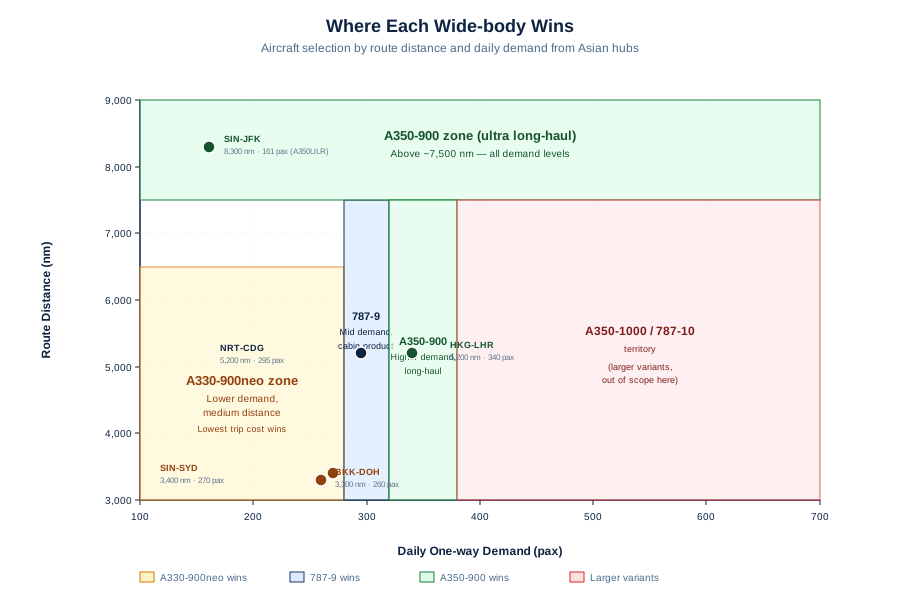
- Daily one-way demand below ~280 passengers: A330-900neo wins. Lowest acquisition cost, lowest trip cost, single pilot type rating commonality with A330ceo fleets, dense layout maximises seat count for cost-sensitive operations.
- Daily one-way demand 280 to 320 passengers: 787-9 wins. Sized to the demand, range adequate for most Asian long-haul, strong passenger appeal through cabin pressurisation and humidity, mid-range acquisition cost.
- Daily one-way demand 320 to 380 passengers: A350-900 wins. Higher capacity ceiling in denser configurations captures the demand. Wider cabin allows more competitive premium-cabin product, which matters on premium-heavy routes.
- Daily one-way demand above ~380 passengers: A350-1000 or 787-10 territory (larger variants), or twin daily A350-900 if frequency strategy demands it.
These thresholds assume a single daily frequency. If the route can support two daily frequencies, smaller aircraft become more competitive because the frequency benefit captures business traveller premiums, and the per-flight load factor stays healthy on each rotation.
4. The Asian carrier deployment patterns
Looking at how actual Asian carriers deploy these three aircraft confirms the framework above. The deployment patterns are not random.
Singapore Airlines operates all three. The A350-900 (standard, regional, and ULR variants) covers the broadest mission set, from ultra long-haul (SIN-JFK, SIN-LAX, SIN-LHR) down to medium-haul regional. The 787-10 (note: not 787-9) covers medium-haul Asian routes with higher capacity. The A330ceo previously covered medium-haul but is being progressively retired.
Cathay Pacific has a strongly Airbus-leaning widebody strategy. The fleet centres on A350-900s and A350-1000s alongside Boeing 777-300ERs for higher-demand routes and the older A330-300 for regional Asia. The 787 family is absent from Cathay’s current widebody fleet. In August 2024, Cathay placed a firm order for 30 A330-900neos (plus 30 options) to replace its aging A330-300s, confirming the Airbus-leaning direction.
Japan Airlines and All Nippon Airways both operate substantial 787 fleets (a Boeing home-team effect, as Japanese suppliers produce significant 787 structures) alongside A350-900s. The 787-9 covers thinner long-haul (Tokyo-Helsinki, Tokyo-Boston, Tokyo-Seattle), while the A350-900 covers higher-volume long-haul (Tokyo-London, Tokyo-Paris, Tokyo-Frankfurt).
Korean Air operates 787-9s alongside A330-900neos. The 787-9 handles the long-thin US routes, the A330-900neo handles medium-haul Asia and intra-regional long-haul (Seoul-Bangkok-Sydney, for example).
Air China, China Eastern, and China Southern all have mixed 787 and A350 fleets. Mainland Chinese carriers were also strong A330ceo operators historically, and the A330-900neo is replacing those older airframes as they retire.
Vietnam Airlines operates A350-900s alongside Boeing 787-9s and 787-10s. The widebody fleet is deployed on a mix of long-haul international routes and high-density domestic trunks (the Hanoi to Ho Chi Minh City corridor sees regular widebody service).
Thai Airways, emerging from restructuring, is consolidating around the A350-900 and 787-9 for its long-haul fleet, having retired the older 747-400 and A380 types.
The pattern is consistent: every serious Asian long-haul carrier operates either an A350-only widebody fleet, a 787-only widebody fleet, or some combination of both. The A330-900neo is the third option, used either as the budget alternative or as the replacement for retiring A330ceo airframes.
5. The non-economic factors
Range and capacity drive most of the decision. Several non-economic factors can override:
Manufacturer commonality. A carrier with an existing A330ceo fleet has compelling reasons to add A330-900neos: shared pilot type ratings, shared maintenance procedures, shared cabin design language. Korean Air’s choice of A330-900neo over 787-9 for medium-haul is partly explained by this. Conversely, a carrier already heavily Boeing-committed (ANA’s 787 fleet is among the world’s largest) finds it operationally easier to keep adding 787s rather than introduce an Airbus type.
Engine choice. All three aircraft offer Rolls-Royce as an option. The 787-9 also offers GE GEnx as an alternative. Some carriers have strategic relationships with one engine maker (often tied to maintenance contracts) that influences aircraft selection. Singapore Airlines’s GE relationship has historically pushed it toward GE-engined 787 variants when those were under consideration.
Cabin product. The A350’s wider cabin allows for slightly more comfortable economy seating at the same seat count. The 787’s higher cabin pressure and humidity is the standard for passenger experience marketing. The A330-900neo offers the A350-style cabin features at a lower acquisition cost. Carriers with premium positioning (Cathay, Singapore Airlines, JAL) tend toward the A350. Carriers with cost-sensitivity tend toward the A330-900neo.
Delivery slot availability. Boeing’s 787 program has experienced extended delivery delays since 2019. Airbus’s A350 program has its own backlog but generally shorter delivery times. A carrier planning a fleet renewal in 2026-2027 may find A330-900neo deliveries available within 12 months, A350-900 deliveries 18-24 months, and 787-9 deliveries 24-36+ months. This availability gap has driven some recent fleet decisions, including several Asian carrier orders for A330-900neos that might otherwise have gone to 787-9s.
Production geography and trade relationships. Aircraft purchases of this scale carry geopolitical weight. Mainland Chinese carriers ordering Boeing aircraft signal something different from ordering Airbus, particularly in the post-2018 era. Japanese carriers ordering Boeing reflects the deep supplier relationships between Japanese manufacturers and the 787 program. These factors are rarely decisive on their own but contribute to fleet-strategy outcomes.
6. The freight question
Long-haul widebodies carry both passengers and cargo. The cargo contribution to route economics is non-trivial: a fully loaded passenger widebody on a typical Asia-Europe routing might generate 25 to 35% of its revenue from belly cargo.
The three aircraft differ on cargo capacity:
- A330-900neo: typically 17 LD3 positions or 4 to 5 pallets, lower deck.
- 787-9: typically 28 LD3 positions, lower deck. The Dreamliner’s longer fuselage and more efficient cabin packaging gives it a cargo advantage in this size class.
- A350-900: typically 36 LD3 positions, lower deck. Largest cargo capacity of the three by some margin.
For routes where belly cargo is a significant revenue contributor (Asia-Europe trade lanes, Asia-North America trade lanes), the A350-900’s cargo advantage adds another reason to favour the larger aircraft. For routes that are primarily passenger demand with modest cargo, the cargo difference matters less.
7. The ultra-long-haul question
The ultra-long-haul market (above 7,500 nautical miles) is essentially A350-only territory. Singapore Airlines, Qantas (with A350-1000ULRs entering service for Project Sunrise), and a handful of other carriers operate flights at this range. The 787-9 cannot reach these markets at full payload. The A330-900neo cannot reach them at all.
This is why every major Asian carrier looking at growth into the East Coast US market (BKK-JFK, KUL-JFK, MNL-JFK, HAN-JFK) is in some stage of A350 evaluation. The aircraft is, for now, the only commercial option for these routes. Boeing’s response (a 787-10ER concept, or further range extensions to the 777X family) is years from market availability.
The Asian long-haul map is therefore changing in a specific direction: more A350-900 and A350-1000 fleets, more ultra-long-haul routes that bypass intermediate connecting hubs, and a gradual decline in the role of the connecting traditional Gulf hub for Asia-North America connectivity. Emirates and Qatar Airways still dominate the connecting traffic, but direct point-to-point on A350s is eating into that share market by market.
8. Practical fleet planning rules for the Asian long-haul
For anyone making real fleet selection decisions on real Asian long-haul routes, three working rules:
Rule 1: Match the aircraft to the route’s distance and demand profile, not the marketing brochure. A330-900neos on medium-haul Asian routes outperform 787-9s on the same routes by 10-15% on unit cost. 787-9s on ultra-long-haul routes either cannot operate or operate with severe payload restrictions that destroy the unit economics. The aircraft must match the mission.
Rule 2: Treat fleet commonality as a hard cost. Adding a third widebody type to an operation that already has two imposes major training, maintenance, and operational complexity costs. Carriers should resist the temptation to mix aircraft families unless the route economics genuinely justify it. Many Asian carriers have ended up with sub-optimal fleet mixes that are difficult to rationalise without taking the operational disruption of fleet simplification.
Rule 3: Plan for the delivery slot, not just the choice. The aircraft you can have in 18 months is more useful than the aircraft you would prefer in 36 months. Boeing’s 787 backlog and Airbus’s A350 backlog both constrain real fleet renewal timelines. The A330-900neo’s relative delivery availability is a meaningful competitive advantage that fleet planners should weigh.
Closing
The 787-9, A350-900, and A330-900neo are the three aircraft that will define Asian long-haul fleets for the next 15 years. None of them is universally superior. Each wins in specific zones of the distance-demand-economics space, and the Asian carriers that get fleet selection right are the ones that match aircraft to mission precisely, rather than picking favourites and forcing routes to fit.
For practitioners building or refreshing widebody fleets in the region, the working approach is the same as any sound fleet selection exercise: get the demand right first, get the distance right second, then layer in cargo, commonality, and delivery-slot realities. The aircraft will sort itself out.
This article uses publicly available aircraft specifications from Boeing and Airbus, and reflects general industry observations of Asian carrier deployment patterns. Specific carrier fleet decisions involve commercial, financial, and strategic factors not visible from public data. Aircraft selection for actual route planning should incorporate the operator’s specific cost structure, network requirements, and the manufacturer flight manuals applicable to the relevant variants.